Heliotropic: A case study by New Nostalgia
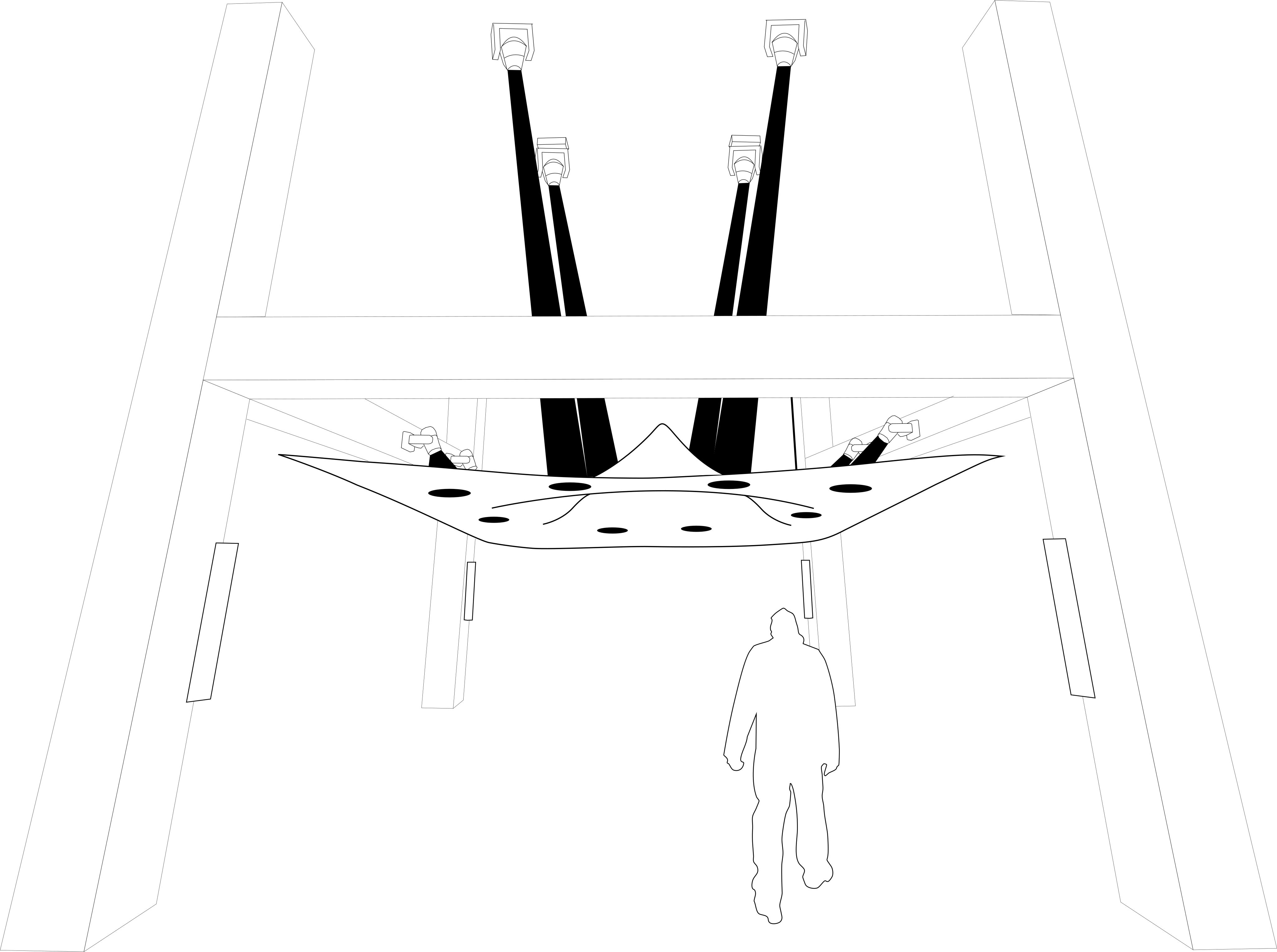
Heliotropic is a Thursday club night series at Public Works SF hosted by New Nostalgia and Public Release. The dance floor features a 20ft tensile canopy structure suspended over the crowd. The fabric functions as a new lighting fixture, casting spots, washes, and patterns from the lights overhead. Heliotropic features a secret, unannounced DJ lineup. Heliotropic 2, on June 11th, was a collaboration with Teenage Engineering with all of the lighting fixtures controlled by an OP-XY, a TX-6, and two K.O. IIs.
Heliotropic Installation View, Public Works, San Francisco, CA, 2025
Photo Aakash Malhotra
Ice blue Heliotropic 2 installation view
Photo Aakash Malhotra
Moving head beams refracting off top of fabric with attendees underneath
Photo Colby Xavier Riley
Crowd under fabric, bright orange diffusion through shadows
Photo Abraham Melecio
Complementary colors cast while attendees underneath fabric
Photo Colby Xavier Riley
Crowd dancing underneath fabric, blue color wash
Photo Colby Xavier Riley
Lighting team operating lighting movements in front of crowd
Photo Colby Xavier Riley
Crowd dancing underneath fabric, darker red & orange color wash
Photo Colby Xavier Riley
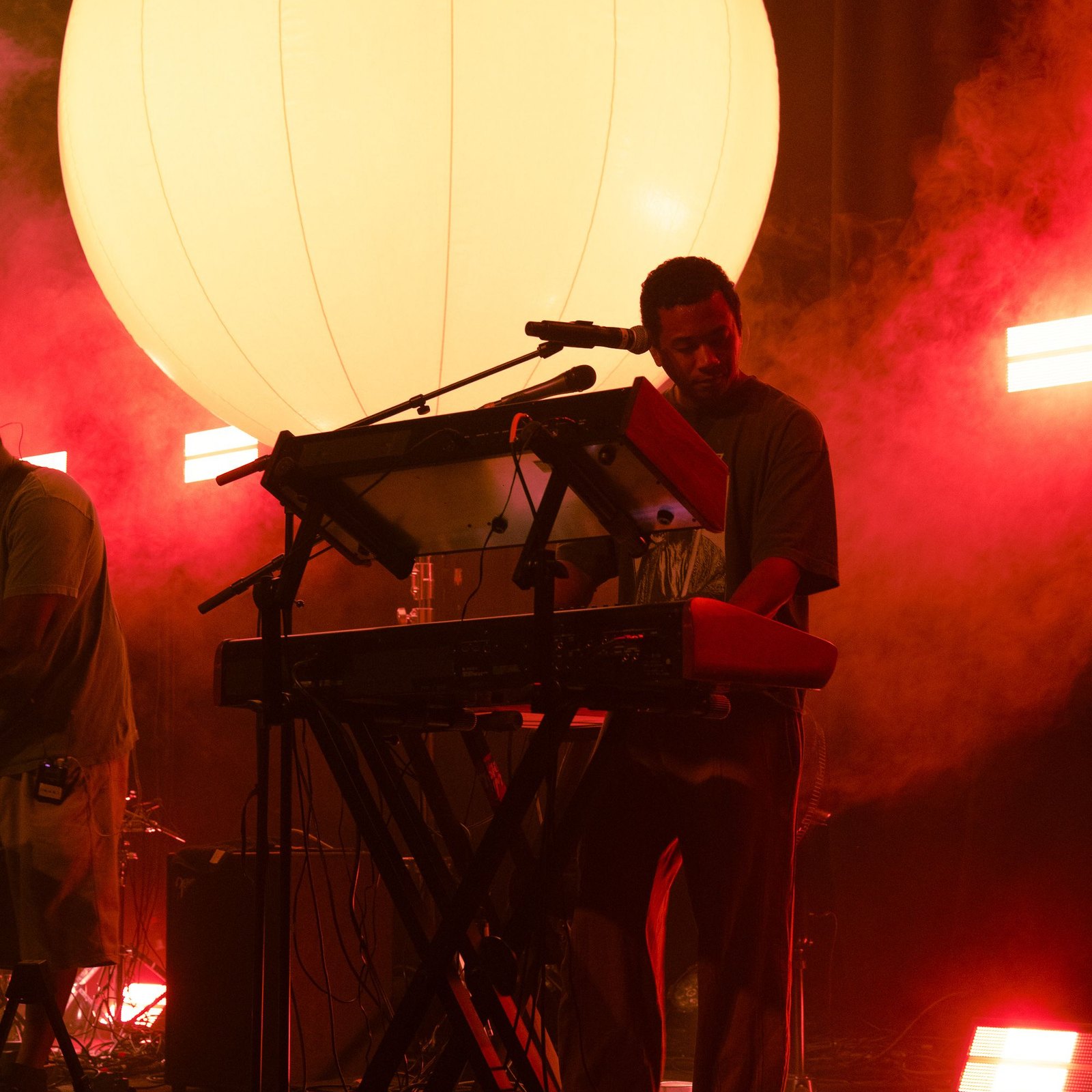
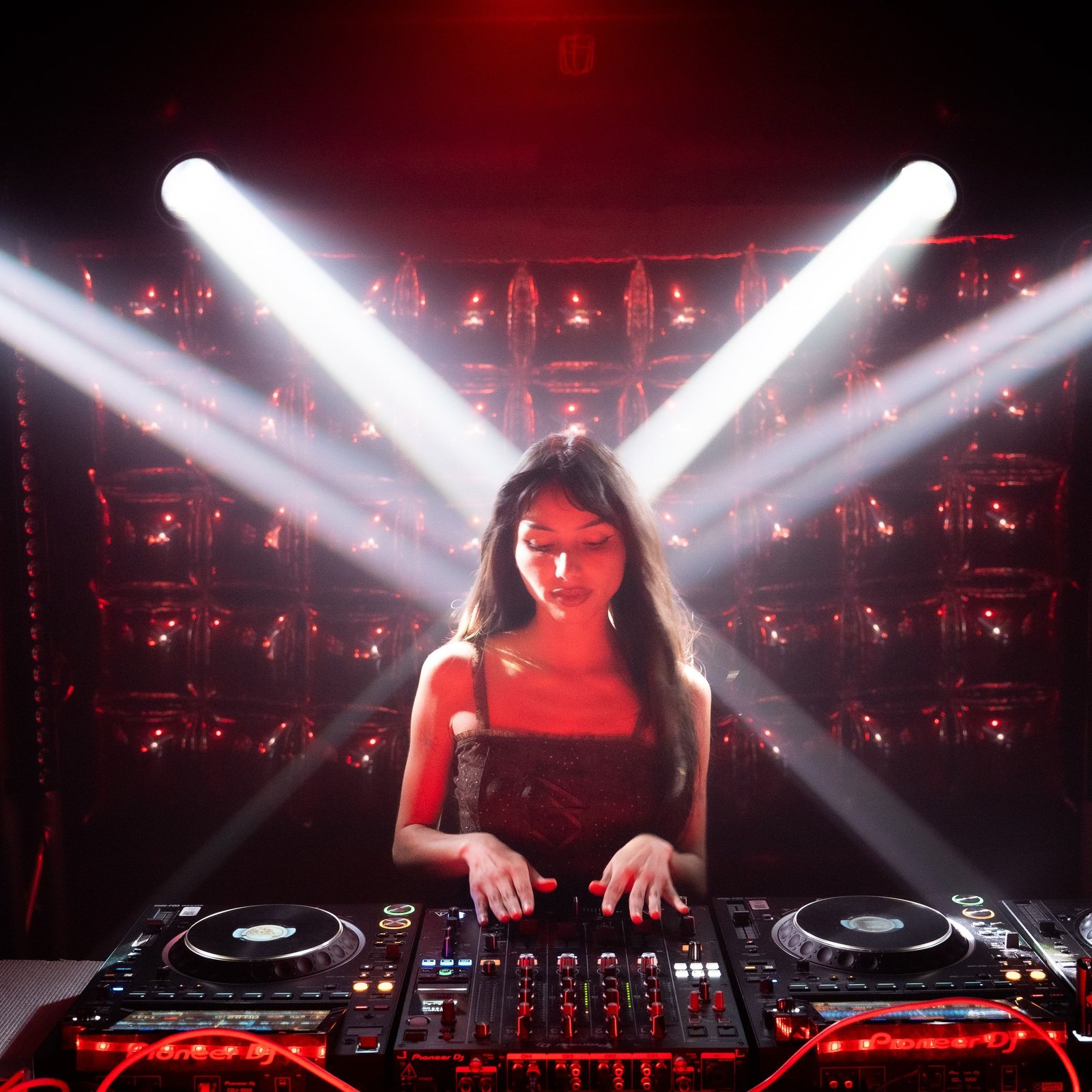
Chazwick Bear DJing during Heliotropic 2
Photo Colby Xavier Riley
New Nostalgia member under fabric, bright orange burst pattern with orange color wash
Photo Aakash Malhotra
Lighting operators during Heliotropic 2 pre-production
Photo Aakash Malhotra
Kelly He and Karla Limon operating Teenage Engineering gear during Heliotropic 2 pre-production
Photo Aakash Malhotra
Kelly He operating lighting with TX-6 during Heliotropic 2 pre-production
Photo Aakash Malhotra
Teenage Engineering Gear displayed on table during Heliotropic 2
Photo Aakash Malhotra
Flyer for Heliotropic
Graphic Brendan Luu
Flyer for Heliotropic 2
Graphic Brendan Luu
Introduction
Mainstream nightlife in 2026 optimizes for grandiose spectacle, with the audience as passive consumers of the show. It’s too familiar a scene to be at a show featuring a large proscenium stage and a DJ’s graphic logo rotating across an LED video screen behind them.
No hate, we’ve all experienced some transcendent, melting-all-problems-away moments with an artist or live performance. The issue: the increasingly rare instances where you yourself are the spectacle instead of witnessing it.
Technology, through iPhone cameras, CDJ 3000s, and VIP tables, has succeeded in creating moments of undeniable spectacle — but what new technologies break the sense of watching the spectacle happen? The very spectacle happening within us, as postwar artist Willoughby Sharp describes it, in a “shift from being to becoming.”1
This shift into being the spectacle is increasingly important as it’s one of the few places where we are unconditionally present—a method of reclaiming space where attention isn’t being harvested or shaped by someone else’s ideas.
Heliotropic translates to “orienting towards the light (sun).” Our intention was to break the normal orientation towards the DJ, stage, or spectacle and reorient towards a new, temporary shelter — a shared roof — above all of our heads. Wherein there is “no proscenium stage, set aside, for the spectators to watch…we are inside the spectacle, immersed.”2
1. Newness
Sitting at SPRO in San Francisco’s Castro/Mission neighborhood, Public Release founder Eugene Whang was flipping through videos of his decade-old party at 1015 Folsom, which featured DJ sets from DJ Harvey and Virgil Abloh alongside Swiss-ball-sized disco balls.
The shipped-in disco balls — rigged with a bespoke motor to ensure slower-than-normal turning — created a beautiful speckled field of light across the entire dance floor, rendering 1015 Folsom and the 30+ nights we’d spent there unrecognizable.
In this shared interest in radical newness — especially after sharing sentiments about club nights feeling the same — we wanted to reimagine Public Works as a new space.
2. Womb
We love that fog — a phenomenon that occurs both in nature and in nightclubs — can provide the same “models of egoic dissolution and reintegration” that Sharp attributes to kinetic installations in his 1967 book Light/Motion/Space.
Our physical realities need more chances to feel fluidly fucked with. But what else besides fog can comfortably provide that?
In searching for our nugget of inspiration, we stumbled across a photo of the seating area at Electric Circus, the psychedelic 1960s NYC nightclub. A few stacked benches with a large canopy stretched low above the resting partygoers’ heads — the photo invoked a raw feeling, one of comfort, in an almost womb-like environment.
Our intention was to have similar themes of casualness and domestication — almost like a house party wherein the music is great and loud but no one faces the DJ. A feeling rarely granted in public spaces, and much rarer at a nightclub.
We designed, ordered, and delivered a custom 20’×20’ projection’ fabric, tailor-made for the Public Works dance floor to replicate the feeling of the womb-like indoor canopy seating area.
Traditional pop-up tent structures usually rely on in-ground footings or surface base plates with large structural poles to produce the organic curves from tension. To avoid the facade of a large pole emerging from the center of the dance floor, we instead created tension by pulling the fabric up with a rope and pulley mounted on the ceiling.
The result was a rectangular roof tent with an organic catenary curve and a defined center point — almost like a teepee or a big-top circus tent. The center almost sucked your spirit upward, with the hyperbolic depth of a black hole or a vibrant sunflower.
Covering the entirety of the dance floor between four columns and blocking visibility of anything beyond the fabric roof manipulated our hard-edged perception of ceiling and walls. The simple, lightweight piece immersed us in something that dissolved depth entirely.
3. A New Fixture
The projection fabric served as the perfect light-diffusion material, casting large spots and patterns from the spotlights and moving heads. These patterns wouldn’t be typically seen as the lights usually terminate hitting the heads of dancers in the crowd.
A series of stage panels create rich, single-color washes — turning the whole fabric salmon, purple, or pink. Battery strips, also placed on the inner columns, would light up the fabric from the inside — matching or complementing the color washes to create new palettes.
Light shot at the disco ball created a beautiful, uniform speckled field of light that terminated on the fabric like a freckled kid or a dot-spotted dog.
The overall effect of this new lighting fixture was the transformation of the tent — not just something like a simple canopy but something with far more personality. It became an immersive environment — rotating, evolving, strobing in a number of unique ways.
At Heliotropic 2, all of the lighting fixtures were controlled by Teenage Engineering equipment: the ability to pan the moving heads, adjust the speed of chases, and control the color washes was all mapped to a series of buttons across the TE devices.
With the lighting booth visibly fixed within the dance floor, attendees became interested in the “playability” of the lights. A lot of our friends excitedly hopped in, turning, pressing, and rotating the knobs to control the lights. There’s no better environment to feel comfortable in than one where you have the ability to control it.
4. Manipulating Time
We kept the DJ lineups secret before, leading up to, and even during the party — there was no optimal time to come, no “trying to catch the headliner.”
Stripping away information about the DJ left no analysis of the context of whichever identity was playing — just unfiltered digestion of the music itself. In contrast with such defined subgenres and identities in the 2020s dance era (UKG nights, all-black outfit Berlin techno parties), we wanted to create a space that chipped away at that individuality of taste.
The music curation — which had some great DJs such as Toro y Moi, Khotin, zz, Pulse Finder, Espurr, and Menace1997 — spanned a wide range of BPMs, genres, and energies throughout the night, making it hard to guess what came next despite not caring what did.
Conclusion
“New kinds of art should breed alongside new technologies,” Otto Piene proclaimed, describing the now 60-year-old installation Proliferation of the Sun. He further describes how his post-war installations led to an “allover sound: heartbeat. An exercise in staging a new, provisional collective body.”3
Manipulating light, space, and time allows for this perceptual transformation of spectacle allowing for Piene’s “collective body”. For our Thursday night club series — we manipulated light and space through a depth-dissolving 20ft canopy fabric stretched over the dance floor. By announcing no lineup and no posted set times, we manipulated the last piece of perception: time.
By turning the spectacle inward — away from the DJ, the stage, the celebrity booking — and toward a shared roof above everyone’s heads, the canopy didn’t eliminate spectacle so much as relocate it: away from the front of the room and into the collective experience of standing underneath it together.
Technical Overview
This section outlines the technical layout and lighting control system used to construct the Heliotropic installation at Public Works. The installation centered on a suspended stretch-fabric canopy over the dancefloor, with lighting aimed onto the canopy to create a low overhead field of moving light.
1. Canopy & Rigging
The canopy was built from Rose Brand 122” Boost, IFR stretch fabric and tensioned to approximately 19’ × 23’. It was positioned directly over the dancefloor, with the DJ booth and stage sitting outside of the canopy footprint.
The fabric was held from five points. Two corners were attached to structural columns in the venue, while the other two corners were attached to truss positions in front of the stage. The center point of the fabric was connected by carabiner to a rope running through a pulley mounted to ceiling unistrut.
The four corners sat at roughly 7’ high, with the center lifted to roughly 12’. This created a static tented form above the crowd, lowering the perceived ceiling of the room while leaving the dancefloor open underneath.
2. Lighting Layout
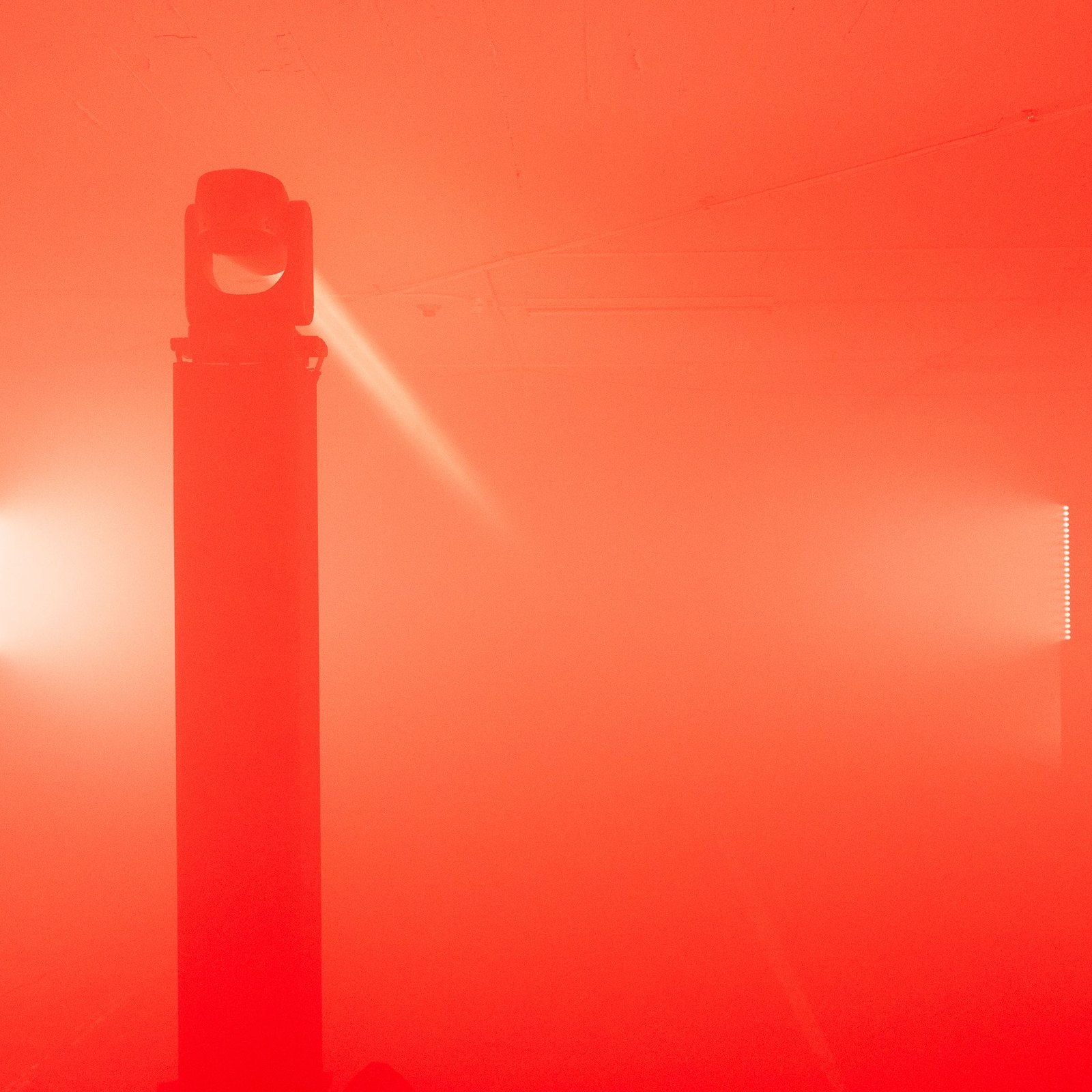
The lighting system used a combination of venue-mounted ceiling fixtures and additional fixtures installed around the canopy. CHAUVET Intimidator Hybrid 140SRs, CHAUVET Intimidator Beam 355 IRCs, and Rogue R1 FX-Bs were positioned from the venue’s ceiling unistrut.
Four Elation Dartz 360s were installed into support beams over the dancefloor at approximately 10’ high, adding a lower angle into the canopy. STAGEART Strobes were also aimed toward the canopy and used as both strobe and wash fixtures, with RGB color output and a white strip for brighter hits.
Four Rockville Battery Strip 24s were hung directly under the four canopy corners and aimed inward toward the center of the room. Together, the fixtures created a lighting field that pushed from the perimeter and ceiling into the fabric above the audience.
In a straight idle position, the moving heads formed a symmetrical 2 × 4 grid on the canopy. The stretch fabric caught the beams as small orb-like points of light above the crowd, making the light feel suspended within the canopy rather than projected only from the ceiling.
3. Lighting Control
All fixtures were controlled through grandMA3 onPC running from a MacBook Pro and output through a grandMA3 onPC 2 Port Node 2K.
Chataigne was used to translate MIDI into OSC messages for grandMA3. This allowed the OP-XY, TX-6, and two EP-133 KO II units to function as live lighting controllers. The hardware was used only for lighting control, with no audio signal or audio-reactive input in the system.
Everything else stayed similar to HoloDome1 in terms of programming: Ableton controlled the show, Max for Live handled OSC messaging, and QLC+ handled DMX output.
4. Atmospherics
Atmospheric density was generated using two CHAUVET Hurricane 1800 fog machines. One fogger was placed near the stage, while the second was positioned toward the back of the dancefloor.
5. Gear Summary
Scenic / RiggingRose Brand 122” Boost, IFR stretch fabric1× pulleyRope5× carabiners
Lighting2× CHAUVET Intimidator Hybrid 140SR2× CHAUVET Intimidator Beam 355 IRC4× Elation Dartz 3604× STAGEART Strobe2× Rogue R1 FX-B4× Rockville Battery Strip 24
Atmospherics2× CHAUVET Hurricane 1800 fog machines
Control / Software1× MacBook Pro1× grandMA3 onPC 2 Port Node 2KgrandMA3 onPCChataigne1× Teenage Engineering OP-XY1× Teenage Engineering TX-62× Teenage Engineering EP-133 KO II
Crowd during Heliotropic 2, Public Works, San Francisco, CA, 2026
Photo Colby Xavier Riley
Citations
- 1 Sharp, Willoughby. “Luminism: Notes Toward an Understanding of Light Art.” Light/Motion/Space, exhibition catalog, Walker Art Center, 1967, pp. 4–11.
- 2 Patterson, Zabet. “Turning On: Technological Circuits in USCO and Zero.” Between the Viewer and the Work: Encounters in Space: Essays on ZERO Art, edited by ZERO Foundation et al., arthistoricum.net, 2019, pp. 83–92.
- 3 Piene, Otto. The Proliferation of the Sun. 1966–67. spruethmagers.com/exhibitions/otto-piene-the-proliferation-of-the-sun-los-angeles/.
Published by
- Group:
- New Nostalgia
- Printing:
- New Nostalgia, or you
Production by
- Executive Production:
- Eugene Whang
- Lighting Technicians:
- Kelly He, Karla Limon, Lucas Mills
- Sewing:
- Maddie Meharg
© 2026 by New Nostalgia
Created in San Francisco, CA, USA
All rights reserved
First edition, July 2026